
Complementary procedures
At Janssen Zurich, we emphasise a holistic treatment of all facial areas.
Facelifts are therefore often combined with:
- Brow lift
- Upper eyelid lift
- Lower eyelid lift
- Lip lift
- Fat transfer
How does a brow lift work?
With increasing age, the forehead and eyebrows tend to sag slightly.
A brow lift is an effective method for correcting this process.
Effects:
- Correction of a tired-looking appearance
- Reduction of excess skin in the lateral upper eyelid area ("hooding")
- Improvement of frown lines
- Harmonising a look that appears stern or tired
Gliding Brow Lift
Through special suturing techniques ("quilting"), larger scars can be avoided.
Advantages:
- Minimally invasive
- Short recovery time
Temporary numbness or itching are possible.
Temporal Brow Lift
Endoscopic Brow Lift
- Small incisions hidden in the hairline
- Natural, long-lasting results
- Proven efficacy and patient satisfaction (BJPS, 2002)
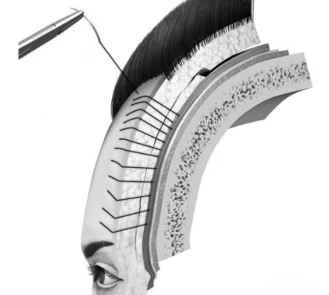
Gliding Brow Lift
Blepharoplasty (Upper and lower eyelid lift)
Upper eyelid lift
In an upper eyelid lift, the following are removed or reshaped:
- Excess skin
- Muscle portions if necessary
- Fat pads
The incisions are placed in the natural eyelid crease and are nearly invisible after healing.
Lower eyelid lift
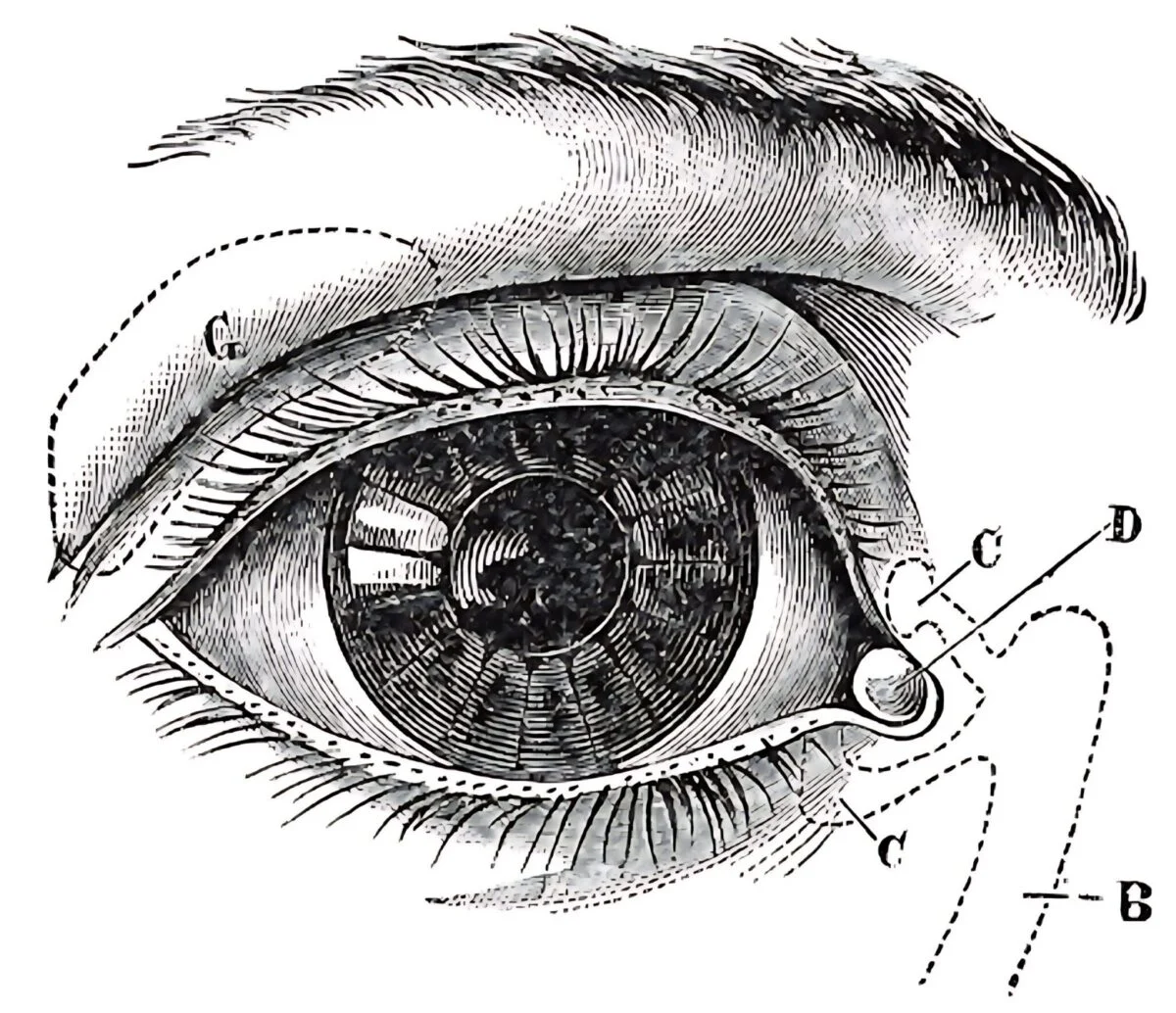
Transconjunctival blepharoplasty
- Incision on the inside of the lower eyelid
- No visible external scar
- Removal/repositioning of fatty tissue
Fat repositioning
In case of volume loss:
- Fat is sculpted or redistributed
- Possibly supplemented with autologous fat
CO2 laser treatment
For additional treatment of fine wrinkles in the lower eyelid skin.
CO₂ laser treatment is often used as a complement to a facelift to improve skin quality. While the facelift repositions the deeper tissue layers, the laser treats fine wrinkles, particularly in the lower eyelid area.
The laser stimulates skin renewal and collagen production. When combined with a facelift in which no excess skin is removed, the result is a balanced outcome of improved skin quality and preserved natural facial structure.
Canthopexy for stabilisation
Depending on the findings, the lower eyelids can be:
- Tightened
- Smoothed
- Revitalised (re-volumised)
If necessary, a canthopexy stabilises the lower eyelid. In this procedure, the eyelid ligament is tightened and fixed in a slightly raised position to improve the eyelid contour and support the lower eyelid.
Important note
Excess skin on the upper eyelid is in most cases caused by a drooping of the eyebrow and the temporal region.
In these cases, a brow lift often achieves more natural results compared to an upper eyelid lift.
Complications after blepharoplasty
Mostly minor and temporary.
Possible problems:
- Rounding of the lower eyelid
- Ectropion
- Asymmetries
- Sunken lower eyelid ("hollowing")
- "Operated" look (post-blepharoplasty syndrome)
In severe cases, secondary procedures may be necessary:
- Canthopexy
- Endoscopic midface lift
- Fat transfer
Special medical cases
Thyroid disorders can cause:
- Protrusion of the eyes
- Retraction of the eyelids
and often require more complex procedures involving bone and soft tissues.
Ptosis due to muscle weakness must be diagnosed before surgery — blepharoplasty alone will not correct it.
Buccal Fat Removal (Removal of the Bichat fat pad)
In buccal fat removal, the fat pad in the cheek area is specifically:
- reduced and/or
- repositioned
to achieve a slimmer, more defined facial shape.
The procedure is minimally invasive and performed through a small, completely invisible incision in the oral mucosa.
This method is particularly suitable for patients who desire a slimmer midface contour without external scars.
Lip Lift (Upper lip lift)
The incision is placed discreetly in the natural fold under the nose. It can take up to a year for the fine scar to fully heal and fade.
A lip lift also provides a lasting improvement in lip shape and fullness, so that non-surgical lip treatments with fillers are often needed less frequently.
Chin correction (Genioplasty)
In some cases, this is due to an underdevelopment of the entire lower jaw, but for most patients a relatively simple procedure is sufficient to improve chin projection.
Chin implants
- Most straightforward method for chin augmentation
- However, possible risk of infection or implant rejection
Advancement genioplasty (surgical chin advancement)
An alternative method is the surgical advancement of the patient's own bone, which:
- Requires no foreign material
- Is well tolerated
- May cause temporary numbness of the lower lip (usually completely reversible)
Fat injections / autologous fat transfer
A relatively new option for milder cases:
- Enhancement of chin contour with autologous fat
- Particularly natural effect
- Ideal for subtle accentuation
The reliability of modern chin augmentation techniques has improved significantly in recent years.
An individual assessment is crucial to determine the best procedure for the specific anatomy.
