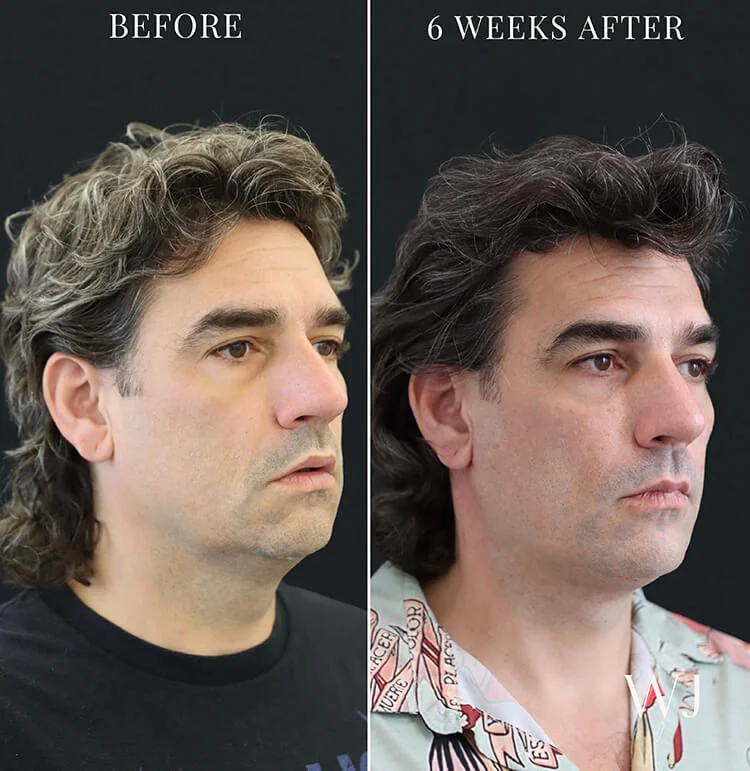
Deep Plane Facelift
About the Deep Plane Facelift
We specialise exclusively in facial rejuvenation procedures, and our techniques are based on the experience of over 100 facelift surgeries performed annually.
The quality and precision of modern methods for restoring a youthful appearance have advanced significantly in recent years.
The traditional "facelift," in which only the skin was tightened and re-draped, is now rarely performed.

Procedure & Advantages of the Deep Plane Facelift
A deep plane facelift achieves a fresh and more youthful appearance.
The scars are placed discreetly in natural skin folds and behind the ear, typically fade quickly, and are barely visible.
Facelifts are often combined with complementary procedures to address neck ageing.
In cases of pronounced neck laxity, an additional, well-hidden incision in the submental crease may be necessary to correct the deep structures of the neck and achieve long-lasting results.
Complications after facelifts are rare.
Historically, postoperative bleeding (haematoma) in the first few hours after surgery was the most common complication.
A study published by us on the so-called Hemostatic Net (American Aesthetic Surgery Journal, 2024) shows that this technique almost completely eliminates the risk of postoperative bleeding.
Careful preparation includes checking:
- General health
- Allergies
- Current medication
- Complete medical history
The choice of procedure depends on the anatomical conditions as well as the goals of the patient.
Types of facelift techniques
Secondary facelifts (revisions)
Secondary facelifts are among the most technically demanding procedures.
Typical problems after previous surgeries include:
- premature skin laxity due to inadequate treatment of deep structures
- unnatural, "operated" appearance from excessive skin tightening
- lack of stabilisation of the deep tissue layers
- different vectors and directions of lift leading to disharmonies
- often greater elevation of the lower half of the face than the midface
In cases of obvious deformities after a facelift, we recommend a waiting period of at least 12 months before performing a revision.
MACS lift or short-scar facelift
Suitable for patients with mild to moderate jowls.
Advantages:
- No scars behind the ears
- Short recovery period
- Effective tightening of the mid and lower face
(Note: shorter durability compared to deep plane methods)
Hidden-Incision Necklift ("Weekend Lift")
The Hidden-Incision Necklift is suitable for patients who wish to avoid visible incisions on the face.
In this procedure, superficial and deep neck structures are treated via hidden incisions in the natural fold behind the ear.
Well suited for:
- Excess fat/tissue under the chin
- Vertical platysmal bands
- Sagging of the deep neck structures
- Moderate skin laxity
Smasectomy-Facelift
Ein von Dr. Baker (USA) entwickeltes Verfahren, das jüngst wieder an Popularität gewonnen hat — u. a. bekannt durch die Behandlung von Kris Jenner.
Ein SMASectomy-Facelift ist:
- für viele Patientengruppen geeignet
- natürlicher als oberflächliche Hautstraffungen
- mit kurzer Ausfallzeit verbunden
Extended Hidden-Incision Necklift
This procedure rejuvenates the lower face and neck as a unit and creates a harmonious overall appearance with minimally visible scars.
Suitable for:
- Early to moderate midface ptosis
- Sagging of the lower face and jowls
- Lack of definition of the chin-neck line
- Excess skin in the neck area
The neck region is lifted and contoured together with the jawline.